
A splitting machine that is badly installed never performs as designed. Thickness variation that looks like a machine fault is very often a floor that is not level, a feed belt fighting a badly positioned bench, or an operator standing where the material has to be lifted rather than slid.
This guide covers what to prepare before the machine arrives, and what to check on the day it runs for the first time.
Floor and foundation
Three things matter: level, flatness and load capacity.
- Level. A band knife machine is sensitive to frame twist. If the floor is out of level, the frame distorts and the blade no longer sits square to the pressure foot, which produces a wedge across the split width. Check with a machinist's level in both directions; shim under the feet rather than forcing the frame.
- Flatness. Local hollows under a foot mean the machine is standing on three points and rocking on the fourth. Fill, grout or shim — do not rely on the levelling bolts alone to bridge a 10 mm hollow.
- Load. A typical 600 mm production machine weighs 700–1,200 kg. On four feet that is a static point load of 175–300 kg, and the dynamic load during cutting is higher. A 150 mm reinforced concrete slab handles this comfortably; a suspended upper floor needs checking.
Fit anti-vibration pads or levelling feet with a rubber interface. They reduce transmission of the blade's high-frequency vibration into the building, and they make re-levelling after the first month much easier as the machine settles.
Space envelope and clearance
Buyers routinely underestimate the space required because they measure the machine rather than the working envelope. You need clearance on all four sides, and the amount differs by side.
| Side | Clearance | Why |
|---|---|---|
| Infeed | 1.5× the longest hide you will split | Full hides must lie flat and unsupported hides drag |
| Outfeed | 1.5 m minimum, 2 m preferred | Room to receive and stack grain pieces and splits |
| Control side | 1 m | Operator stance and access to the thickness control |
| Service side | 1 m | Blade change, wheel access, inspection covers |
| Above | 500 mm | Opening covers, hoisting during maintenance |
Also measure the route in: doorways, lift dimensions and turning circles. A 820 mm machine is roughly 1.6 m wide and 1.2 m deep on its crate, and it will not go through a standard 800 mm office door. If the route is tight, plan the crate opening at the door rather than in the workshop.
Power supply and electrical
Check the nameplate before anything else, and check it against the site supply rather than the other way round.
| Machine class | Typical motor | Supply | Notes |
|---|---|---|---|
| Small mechanical, 300–400 mm | 3–4 kW | 3-phase | Often single-speed, simple starter |
| Production mechanical, 500–600 mm | 4–5.5 kW | 3-phase | Variable feed speed on many models |
| CNC / servo, 600–820 mm | 5.5–7.5 kW | 3-phase + neutral | Servo axis and control cabinet; separate circuit recommended |
Practical points that cause problems on site:
- Voltage and frequency. 380 V/50 Hz, 220 V/60 Hz and 440 V/60 Hz machines are all built, and a 50 Hz machine on a 60 Hz supply runs 20% fast. Confirm both figures.
- Separate circuit. Do not share a circuit with welders or large compressors. Voltage dips show up as thickness variation on servo machines and as erratic feed on any machine.
- Earthing. A proper earth is a safety requirement, and on CNC machines it also matters for noise on the control signals.
- Cable route. Route power and control cables away from the dust extraction ducting and from the operator's walking path.
Compressed air and dust extraction
Machines with pneumatic pressure foot loading, pneumatic blade tensioning or air-blast cleaning need a clean, dry air supply — typically 6 bar at the machine inlet, with a filter-regulator unit mounted locally. Water in the air line is a common cause of sticky pneumatic valves and erratic pressure foot behaviour.
Dust extraction matters more than most buyers expect. Splitting produces fine leather dust that settles on the feed belt, the blade guides and the finished material. A extraction hood at the cutting point, connected to a duct with sufficient velocity to keep dust entrained, keeps the machine cleaner, reduces faults and — in workshops with several machines — is usually a health requirement as well as a quality one. Size the duct for the machine's airflow requirement, not for the smallest duct you can fit.
Material flow and layout
The machine should sit in a straight line with the process, not across it. The best layout puts the splitting machine downstream of the storage and inspection table and upstream of the cutting or skiving area, with the infeed facing the direction the hides arrive from.
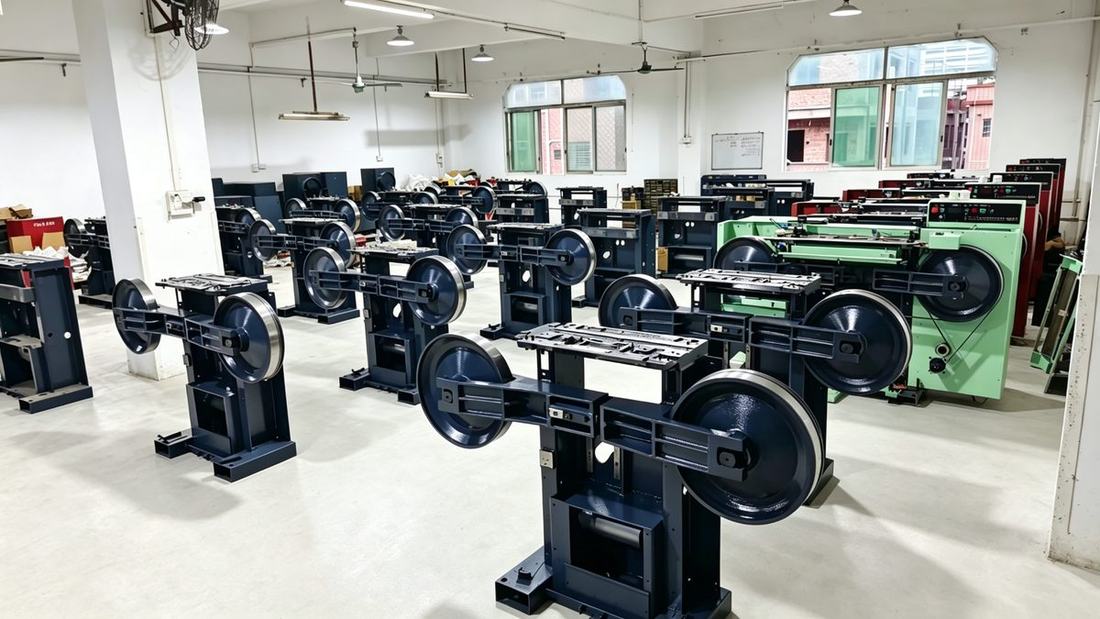
Two layout rules that repay themselves immediately:
- Work surface height matched to the machine. Infeed and outfeed tables at the same height as the machine bed. Lifting a 3 kg hide 200 times a shift is a productivity and injury issue, not a comfort issue.
- One-directional flow. Unsplitted material in from one side, grain pieces and splits out to two clearly separate destinations. Mixed piles at the outfeed are the origin of most thickness mix-ups.
The commissioning checklist
Work through this with the supplier's engineer present, and sign it off. It takes about half a day and it is the difference between a machine that performs and a machine you spend a year adjusting.
- Machine level in both directions, all feet loaded, anti-vibration pads fitted.
- Guards and interlocks tested — every one, deliberately.
- Emergency stop tested from the operator position and from a second position if fitted.
- Blade tracking checked at low speed, then at operating speed.
- Blade tension set to the manual figure, and recorded.
- Feed belt tension and tracking checked; belt cleaned.
- Thickness set, then verified with a physical gauge on test pieces at three positions across the width.
- Machine run for 20 minutes to reach operating temperature, then thickness re-verified.
- Dust extraction airflow measured at the hood, not assumed.
- Operators trained on start-up, shutdown, blade change and what to do when a fault appears.
The first week after handover
Expect the machine to settle. Concrete compresses under the feet, belts stretch, fasteners loosen under vibration. In the first week:
- Re-level after 3–5 days of running.
- Re-check blade tension and feed belt tension after 20 hours.
- Re-torque the fasteners you can reach, to the manual's figures.
- Log thickness at the start and end of each shift — this becomes your baseline, and any future drift is measured against it.
If thickness variation appears in week one, suspect installation before machine fault: level, blade tracking, belt tension, or material being fed at the wrong temperature. Our troubleshooting guide maps symptoms to causes in the order you should check them.
SAMA ships machines with an English commissioning manual, a spare blade and a wear-parts kit, and we support installation remotely by video where travel is not practical. For site requirements specific to a model — footprint, weight, power, airflow — ask us for the layout drawing before you pour the floor.
Frequently Asked Questions
Does a splitting machine need a special foundation?
For most machines up to about 1,200 kg, a level, crack-free concrete floor of at least 150 mm thickness is sufficient, with anti-vibration pads under the feet. Heavier machines and machines installed on an upper floor need a structural check, because the dynamic load during cutting is higher than the static weight suggests.
What power supply does a leather splitting machine need?
Small machines typically run on 3 kW to 4 kW, production machines with servo thickness control and powered feed on 5.5 kW to 7.5 kW, three-phase. Voltage and frequency depend on destination: 380 V/50 Hz in most of Asia and Europe, 220 V/60 Hz or 440 V/60 Hz for other markets. Confirm the exact figure on the machine nameplate before the electrician arrives.
How long does installation and commissioning take?
A single machine with no dust extraction typically takes one day to position, level and connect, and half a day to commission and train. Allow an extra day if you are installing an extraction system, a compressed air line, or if the machine must be moved through a narrow doorway.
Can the machine be installed on an upper floor?
Often yes, but you must check two things: the point load under each foot, and the dynamic load during cutting. A 900 kg machine on four feet is roughly 225 kg per foot statically, considerably more dynamically. Get a structural opinion rather than assuming, particularly in older buildings.
Need advice for your production line?
Send us your leather type, target thickness and daily output. Our engineers reply with a recommended model and a quotation within 24 hours.
Request a Free Quote